

A Metronome Doesn't Care If You Forgot the Words. That's Why You Need One.
A metronome isn't just for rhythm. It's a relentless forward momentum that exposes every hesitation in your recall. If you have to stop and think, you're out of time — and that's exactly the feedback you need.
You know the moment. You are running a song, and you hit the second verse. The first line comes out fine, but the second line stalls somewhere between your brain and your mouth. You stop. You think. You find the words. You keep going.
Alone in the living room, this feels like a minor blip. You got it eventually. The song is basically there.
Now put a metronome behind you.
That moment of hesitation, the pause to think, the half-second of silence while your brain digs for the next line — the metronome does not wait for any of it. It keeps ticking. By the time you find the words, you are two beats behind and the train has left the station.
This is not a rhythm problem. It is a memory problem that the metronome is kind enough to expose before the gig does.
The metronome is a diagnostic tool, not a percussionist
Most musicians think of a metronome as a timing aid. It keeps you steady. It prevents rushing. It builds internal pulse. All true.
But if you are practicing with lyrics, the metronome does something more interesting: it removes your ability to pause. And pausing is the thing that lets you pretend you know a song better than you do.
When you practice without a click, you are in control of time. You can stop between sections. You can take a breath before a tricky line. You can pause mid-verse while your brain catches up. None of these pauses feel wrong because you chose them. But the audience did not choose them. The band did not choose them. The song keeps moving whether you are ready or not.
A metronome forces you to listen. It is not just a sound in the background. It becomes an external demand: be here now, or be wrong. If your recall is slower than the tempo, you hear it immediately. If you have to stop and think, the click moves on without you.
That moment of falling out of time is data. It is telling you exactly where your memory is weak — not your rhythm, your memory. The metronome does not care which one it is. It just exposes the gap.
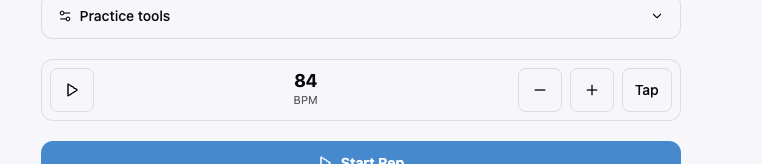
The built-in metronome in Repriso's practice tools. Set a tempo, hit Start Rep, and mark every timing stumble the same as a blank lyric.
The metronome is now built into Repriso's practice tools. Every rep can run against a click — set the tempo, tap it in, or adjust on the fly. When you stumble because the words didn't come fast enough, mark it. The app treats a timing stumble the same as a blank. Both mean the same thing: that section needs more work.
Why free-form practice hides the gaps
Most musicians practice songs the way they read a book: at their own pace, pausing whenever they need to process. This is natural. It feels productive. The problem is that performance does not happen at your own pace.
A gig has forward momentum. The song has a tempo. The audience has expectations. You cannot pause to remember a lyric any more than a runner can pause to remember which direction the course goes.
The gap between "I can play this at home" and "I can play this under tempo" is the gap between comfort and readiness. The metronome closes that gap by making the practice environment harder, not easier. It adds a layer of pressure that is still controlled — you can set the tempo, you can restart — but it is pressure nonetheless.
There is research behind this. A 2011 study on attentional focus in musicians found that when performers practiced under dual-task conditions — playing while attending to an external stimulus — their performance under pressure improved compared to those who only practiced in an unconstrained environment.1 The metronome functions as exactly this kind of dual-task demand. You are tracking the click and retrieving lyrics and playing changes, all at once. That divided attention is closer to what a gig actually feels like than the focused solitude of the living room.
Treat every out-of-time moment as a stumble
In Repriso's practice loop, a stumble is any moment where your recall fails — a blank, a wrong word, a line you had to check the chart for. The app tracks these and schedules that section to come back sooner.
A metronome adds a new category of stumble: the timing stumble. You had the words, but you could not retrieve them fast enough. You fell behind the click. You lost the groove while your brain caught up.
These moments deserve the same weight as a blank lyric. Tap them. Mark them. Let the app bring that section back for more reps. Because if you cannot retrieve the line in time, you do not really have it. You have it at your own pace. And your own pace is not the gig's pace.
Practical ways to use a metronome for memory, not just rhythm
Start slower than performance tempo. If the song sits at 120 BPM on stage, start your metronome practice at 90 or 100. The goal at first is not to match the gig tempo. It is to learn what it feels like to retrieve lyrics with no pauses allowed. Once you can do it clean at a slow tempo, bump it up.
Run the same song at three different tempos. A ballad at 70 BPM requires a different kind of focus than the same song pushed to 100. At slower tempos, the space between beats is long enough that your brain has time to wander. At faster tempos, there is no room for anything but the next word. Both are useful. Both expose different weaknesses.
Mark every timing stumble during the rep. If you fall behind the click, even for a beat, tap it. Do not rationalize it. Do not tell yourself it was close enough. Close enough flies under the radar in free-form practice. Under a metronome, close enough sounds like silence.
Use the metronome on songs you think you know cold. This is where it gets humbling. The songs you have played a hundred times, the ones that feel automatic — put a click behind them and suddenly the bridge has a hesitation you never noticed. The metronome does not care about your track record. It only cares about right now.
The feedback is the point
A metronome is not forgiving. It does not slow down when you are struggling. It does not give partial credit. It delivers one piece of feedback, over and over: you are in time, or you are not.
That feedback is more useful than comfort. Comfort tells you the song is ready. Feedback tells you exactly where it is not.
Run the metronome. Mark the stumbles. Come back to those sections. The click does not lie.
Try Repriso with the built-in metronome →
Footnotes
-
Duke, R. A., Cash, C. D., & Allen, S. E. (2011). Focus of attention affects performance of motor skills in music. Journal of Research in Music Education, 59(1), 44–55. ↩